Monthly Member vs. Drop-in: What is the best way to manage your pickup soccer finances?
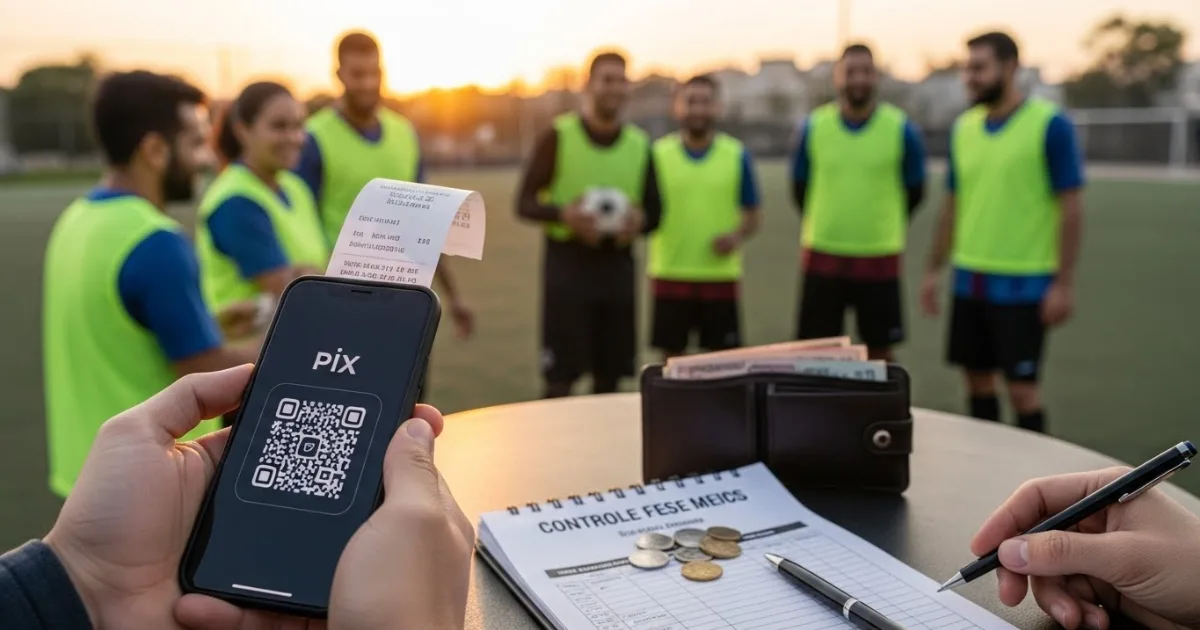
Have you ever experienced the classic situation of finishing a pickup game, sweaty and tired, looking at the payment list and realizing the math doesn't add up? The goalkeeper left early without paying, the winger said he'd make the transfer "as soon as he gets home" (and never does), and you, the organizer, end up paying out of pocket to cover the field rental. If this scene sounds familiar, know that you are not alone. An informal study with several amateur soccer groups shows that financial management is the second biggest cause of pickup games ending, second only to the constant lack of quorum.
Managing money for a group of friends may seem like a simple task at first glance, but it involves nuances of psychology, behavioral economics, and, above all, a lot of patience. The big question hanging over every organizer's head is: Monthly Member vs. Drop-in? Which model ensures the game happens every week, the cash flow stays healthy, and most importantly, friendships remain intact without awkward collections?
In this complete article, we will dive deep into this issue, analyzing the pros and cons of each modality, so you can choose the best strategy for your group and never lose money again.
The Organizer's Dilemma: Stability or Flexibility?
Before deciding on the best model, we need to understand what is really at stake. It's not just about money; it's about commitment and human behavior. How we charge directly affects player attendance and the group's atmosphere.
When we talk about Monthly Member vs. Drop-in, we are talking about two distinct behavioral profiles. The monthly member assumes a medium-term commitment. They "buy" their guaranteed spot and feel part of the team's "hard core". The drop-in player, on the other hand, buys freedom. They pay for the flexibility to decide at the last minute whether to play or not. The secret to healthy financial management is knowing how to balance these two profiles, understanding that each has its role in the pickup game ecosystem.
The Monthly Model: The Base of the Pyramid
The monthly model is the dream of every organizer who values peaceful nights of sleep and less stress on WhatsApp. In this format, a fixed group of players pays a set amount per month, regardless of how many times they attend the games.
Advantages of the Monthly Member
The main advantage is undoubtedly revenue predictability. You know exactly how much will come into the cash flow at the beginning of the month. This allows negotiating discounts with the venue for advance payments or closing quarterly or semi-annual contracts, guaranteeing prime time slots.
Additionally, there is a powerful psychological factor: loss aversion. Humans hate feeling like they are throwing money away. If the player has already paid for the month, the probability of them showing up to the game, even on that rainy, cold day or when they are feeling a bit lazy, is much higher. They want to make their investment worth it. This guarantees quorum and avoids those empty games.
Challenges of the Monthly Model
The challenge here is rigidity. Not everyone can commit to every Tuesday of the month. Work trips, injuries, studies, or family commitments can drive away good players who don't want to pay for games they won't use. If the group is 100% monthly members, you run the risk of having a short roster and struggling to complete teams when there are simultaneous absences, which is inevitable in amateur groups.
The Drop-in Model: The Necessary "Gap Filler"?
In the opposite corner of the Monthly Member vs. Drop-in ring, we have the player who pays per game. They are called to complete the team or join the waiting list, waiting for a dropout.
Why is the Drop-in Player Important?
Financially, the drop-in player can be the "icing on the cake". Many groups charge a slightly higher amount for the drop-in than the proportional value of the monthly fee. This creates a risk premium that helps fatten the group's cash flow. This surplus is fundamental to cover eventual gaps, pay for end-of-year barbecues, or buy new equipment, such as balls and bibs.
Furthermore, the drop-in brings dynamism and renewal. It is the entry point for new talent. That friend from work who plays very well but can't always go is a valuable drop-in who raises the technical level of the match and brings new blood to the social gathering.
The Danger of Default
The big problem with the drop-in model is instability. If it rains, the drop-in gives up. If their favorite team is playing on TV, they give up. And the worst: the collection. Charging piecemeal, game by game, requires military discipline from the organizer. It is very easy to lose track of who paid and who didn't, generating the dreaded "tab" that corrodes the group's finances. "I'll pay you later" is the most dangerous phrase in amateur soccer.
Monthly Member vs. Drop-in: The Math of Balance
So, what is the best choice? Practical experience shows that the longest-lasting and financially healthiest groups do not choose one or the other, but rather a smart combination of the two. The Hybrid Model.
Imagine the following ideal structure for a 7-a-side pickup game (7 outfield + 1 goalkeeper):
- Hard Core (Monthly Members): Have at least 10 to 12 monthly members. They pay the fixed cost of the field. If only they show up, the game happens (5 vs 5 or 6 vs 6). The monthly fee should be calculated to cover 100% of the field cost, with a small safety margin.
- Rotating (Drop-ins): Have a broadcast list with 20 to 30 names of drop-ins. They come in to complete the teams up to 14 or 16 players. The drop-in money becomes "extra cash".
The Golden Rule of Pricing
To encourage commitment, the math must be clear and advantageous for those who commit: being a monthly member must be financially cheaper.
- Practical Example: If the cost per drop-in game is $10.00.
- A month with 4 games would cost $40.00 in the drop-in model.
- The monthly fee should be set at something around $25.00 to $30.00.
This creates a "loyalty discount". The player does the quick math and realizes that if they go to 3 games, it's already worth being a monthly member. This pushes the undecided towards the commitment model, facilitating your management and guaranteeing the team's base.
How to Deal with the "Deadbeat Friend"?
Every group has that nice friend, who plays well, livens up the gathering, but is a terrible payer. They always "forget" or leave it for later. How to deal with this without ruining the friendship?
The answer is: impersonal professionalism.
Don't charge the person, charge the rule. When you establish clear rules for everyone, collection ceases to be something personal ("you owe me") and becomes institutional ("the group needs it"). Use phrases like: "Guys, the group rule is advance payment to confirm the name on the list. The system doesn't let me confirm without the receipt". By blaming the "system" or the "rule", you take the weight off the personal relationship.
Practical Tips to Shield the Cash Flow
Regardless of who wins the Monthly Member vs. Drop-in battle in your group, some management practices are universal to avoid losses and headaches:
1. Digital Payment is King and is Prior
Technology has ended the excuse of "I forgot my wallet" or "I don't have change". Institute the iron rule: name on the list is only confirmed upon sending the receipt. This eliminates 99% of default problems and last-minute dropouts. If the drop-in paid and didn't go, the money stays in the cash flow (unless they find a substitute on their own).
2. Transparency Generates Trust
Keep a simple spreadsheet, but visible to everyone (it can be a link in the WhatsApp group or Google Sheets). Show how much came in, how much went out, and what the current balance is. When the group sees that the money is being well managed and is not going into the organizer's pocket, resistance to paying decreases drastically. They see value in the organization and feel part of the project.
3. Have a Reserve Fund
Never operate on the limit of breaking even. The goal of the cash generated by drop-ins should be to create a safety "cushion". This fund serves to pay for the field on days of torrential rain where the quorum is low, cover eventual field price increases, buy new balls (which are increasingly expensive and last less), or pay for washing the bibs.
4. The Goalkeeper Rule
Does the goalkeeper pay? This is a controversial and cultural question. But, by the law of supply and demand, a good and committed goalkeeper is a luxury item in the amateur market. Exempting the goalkeeper from the monthly fee is a cheap investment to ensure the technical quality of the game. Nothing discourages a team more than having to rotate in goal or play with someone who doesn't know how to play out from the back. Consider the goalkeeper's exemption as an operational cost of the group.
5. Support Tools
Don't rely only on memory or a notepad. Use technology to your advantage. There are specific apps for managing pickup games, but a well-organized spreadsheet in Excel or Google Sheets already solves 90% of the problems. Create tabs for monthly member control, weekly attendance list, and cash flow.
Conclusion
In the Monthly Member vs. Drop-in clash, there is no single and absolute winner. The real winner is the group that manages to balance the financial security of monthly members with the flexibility and extra income of drop-ins, adapting to the reality of its participants.
Managing a pickup game is, at its core, managing people, expectations, and passions. By establishing clear rules, fair prices, and total transparency, you transform the boring and bureaucratic part of collection into a natural process accepted by everyone, allowing the main focus to return to what really matters: well-played soccer, the post-game gathering, and the friendship that strengthens every week.
Organize the finances, define your hybrid model, and see your group prosper on and off the field. And remember: an organized team starts outside the four lines, in the spreadsheet and in the messaging group.
To ensure that, in addition to finances, the teams are also balanced and fair, use our Team Generator in your next match. Avoid cliques, complaints, and technical imbalance with an impartial and fast division!