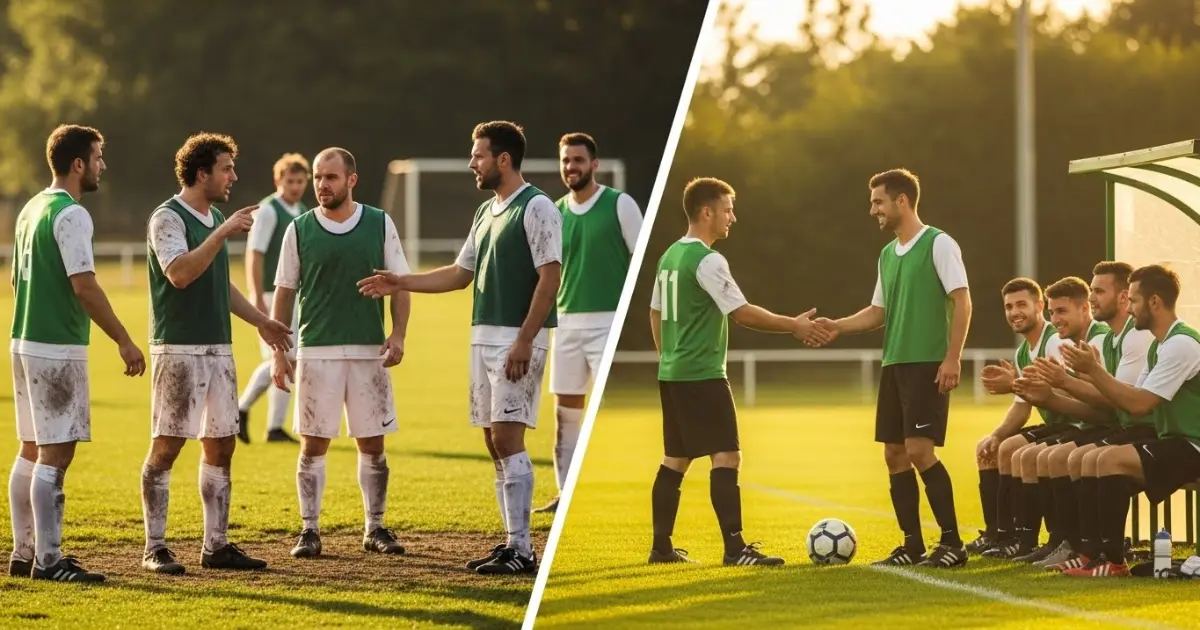
How to Evaluate Player Skill and Build Balanced Teams

Have you ever been at a pickup game where one team wins 10–2 and the match loses its fun before halftime? That scenario is every organizer's nightmare and the number one reason subscribers stop showing up. The difference between an epic, back-and-forth match and a demoralizing blowout comes down to one skill: knowing how to evaluate player skill and build balanced teams.
It's not just about sport; it's about psychology, people management, and a bit of math. Professional clubs spend millions on scouting departments and data analysis. In our world—the amateur football game on Wednesday night or Sunday morning—the challenge is bigger. We deal with unpredictable variables: the star who ate a heavy meal before the match, the goalkeeper who becomes an attacker, and the "rusty" player who happens to be in top form that day.
In this article we'll dive into techniques to change how you perceive players and ensure every match feels like a championship final.
The Science Behind Technical Balance
Before we pick up the clipboard, we need to understand why balance matters so much. Sports psychology studies show human motivation in competitions peaks when the perceived probability of victory is close to 50% for both sides. If the chance of winning is too low, frustration appears. If it's too high, boredom sets in.
To evaluate player skill and build balanced teams, you must go beyond the obvious. The "eye test" often deceives. That flashy player isn't always the most effective for the group. That quiet center back may be the piece that secures defensive stability.
The Friendship and Past-Fame Bias
One of the biggest mistakes when evaluating players is confirmation bias. We tend to overrate close friends or players who had "fame" in the past. "Oh, he played in Flamengo's youth academy in 1998." That doesn't mean he has the fitness or intensity today to balance the game. An honest evaluation requires cold observation of the player's current form.
Practical Criteria for Evaluating Skill
To create a fair system, we need metrics. Saying "he's good" or "he's bad" is not enough. We need a scale. Let's break the evaluation into four core pillars, inspired by professional scouting but adapted to the reality of amateur football.
1. The Technical Pillar (Ball Skills)
This is the easiest to spot. It involves:
- Control: Does the player reliably control the ball or does it slip away?
- Passing: Can they complete short and long passes?
- Finishing: Do they have accuracy in shots?
2. The Physical Pillar (The Team's Engine)
Often ignored, but crucial for building balanced teams.
- Endurance: Can the player sustain effort for the whole match or burn out in ten minutes?
- Speed: Can they win races or recover defensively?
- Strength: Do they handle physical challenges?
A team full of technically gifted players but lacking fitness will lose to a hard-working team that runs twice as much.
3. The Tactical Pillar (Game Intelligence)
This separates the boys from the men.
- Positioning: Do they know where to be on the pitch?
- Game reading: Do they anticipate plays or just react?
- Teamplay: Do they move the ball or try to do everything alone?
4. The Behavioral Pillar (Locker Room Factor)
A toxic player brings a team down even if they're talented. Constant complaining, selfishness, and lack of defensive commitment should lower a player's overall score in your evaluation.
The Position Shortage: Goalkeepers and Center Backs
There's no point in having 20 players if 18 want to be forwards. To evaluate player skill and build balanced teams, consider positional scarcity.
- Goalkeeper: It's the most thankless and most important position. A team with a fixed goalkeeper against a team with "rotating keepers" has an 80% chance to win. If you have regular goalkeepers, treat them as gold. They are your first "seeded players."
- True Center Back: The one who doesn't surge forward all the time. This profile is rare. Often, a technically limited player (Level 2) who holds position at the back is worth more to team balance than a flashy winger who doesn't track back.
When scouting, give extra weight to players who accept playing in these scarce positions. That encourages cooperation and helps the final math of balancing teams.
The 1-to-5 Star Scale: Making Evaluation Practical
To make this practical, use a 1-to-5 scale. It's simple, intuitive, and works well with most team-drawing algorithms (including ours).
- Level 5 (The Star): Decides games. Has technique, fitness, and game intelligence. This is the player you want on your team every time. They dictate tempo, make the team function, and step up when it matters.
- Level 4 (The Good Player): Plays very well and doesn't compromise, but may lack a bit of fitness or big-game decision-making. A valuable, high-quality role player.
- Level 3 (The Average/Regular): Fills out the roster. Doesn't decide games but doesn't ruin them either. The reliable backbone—solid ball control and simple play.
- Level 2 (The Hard Worker): Clear technical limitations but great effort. Needs guidance and may commit simple fouls while compensating with work rate.
- Level 1 (The Beginner): Struggles with skill or fitness. Needs to be carried by teammates and is often there for the social aspect—but integrating them matters for development.
By classifying all your regulars and drop-ins on this scale, you take the first concrete step to evaluate player skill and build balanced teams.
The Dunning–Kruger Effect in Pickup Games
Have you noticed that the worst players are often the loudest complainers about imbalance? This can be explained by the Dunning–Kruger effect, where people with low skill overestimate their competence.
In amateur football, this means a Level 2 often thinks they're Level 4. When they end up on a losing team, they blame the draw instead of their lack of decisive play. As an organizer, you must recognize this psychological aspect. Evaluating player skill and building balanced teams requires firmness and not being swayed by players' distorted self-assessments.
A golden tip: never publish the scores. That avoids bruised egos and endless arguments. Keep evaluations as an administrative tool for you.
Drawing Strategies for Near-Perfect Balance
Now that you have scores, how do you form teams? Throwing jerseys in the air is outdated. Pure random draws rarely produce balanced matches.
The "Pots" or Seed Players Technique
This is the most traditional and effective manual draw method.
- Separate the Level 5 players (seed players).
- Place one in each team.
- Do the same with Level 1 players.
- Draw the rest (Levels 2, 3, and 4) to fill the slots.
This prevents any team from having all the stars or all the beginners—the balance comes from the extremes.
The Spine
Another way to view balance is by position. A balanced team needs a solid "spine": goalkeeper, central defender, and a midfielder/forward. When building balanced teams, ensure each side has at least one good defender and one good playmaker. A team of attackers—even if all Level 5—will likely lose to an organized team with a solid defense.
The Role of Technology in Evaluation
Doing all this in your head or on a napkin is tiring and error-prone—and it breeds complaints: "You put so-and-so in my team on purpose!"
Using a tool or app outsources the "blame" and adds impartiality. Modern algorithms can test thousands of combinations in seconds to find a split where the sums of team scores are as close as possible.
This saves organizers time and legitimizes the teams. Players accept results better when they know a mathematical criterion produced them, not personal bias.
Fine-Tuning: The Organizer's "Feeling"
Even with scores and algorithms, human factors remain. Sometimes two Level 5 players don't gel and clash on the pitch. Or two Level 3 players who have played together for years have chemistry equivalent to Level 5.
Knowing how to evaluate player skill and build balanced teams also means observing these synergies.
- Avoid cliques: If three friends always play together and skew balance, separate them and explain it's for the match's sake.
- Compensate styles: If a team looks weakened, swap a lower-mid player with a higher-mid from the other side.
- Monitor fatigue: In long sessions, first-hour balance may not hold for the second. Be ready to make substitutions if a team "dies" physically.
Conclusion: Balance Is the Key to Fun
Ultimately, the organizer's goal is to see smiles, sweat, and lively post-game banter. Nobody enjoys being a punching bag, and easy wins lose their charm quickly.
Mastering how to evaluate player skill and build balanced teams is what keeps a pickup group thriving for months—or decades. It requires observation, fairness, and sometimes the courage to rate that friend who thinks he's a star as a Level 3. The payoff is worth it: exciting, contested games and the certainty that everyone will show up next week.
Want to make your life easier and guarantee balance with a few clicks? Use our Team Generator to distribute your group's strengths fairly and automatically. Let the math do the work so you can focus on what matters: football.